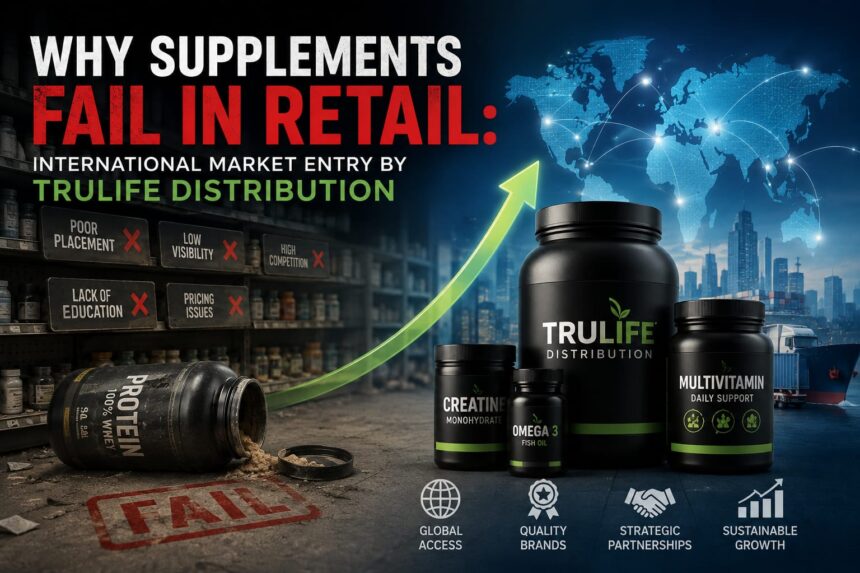
International market entry can be surprisingly unforgiving for supplement brands. A company may have an excellent formula, loyal customers, quality manufacturing, attractive packaging, and years of success in its home country, yet still struggle to gain meaningful traction in U.S. retail.
That does not always mean the product is weak. In many cases, the problem begins after the product is finished.
Retailers are not simply buying capsules, powders, gummies, or functional wellness products. They are evaluating whether a brand can fit their category, meet U.S. requirements, support reliable supply, communicate a clear consumer benefit, maintain workable pricing, and continue supporting the account after the first order.
This is where TruLife Distribution enters the picture. Rather than acting like a conventional retailer that purchases products and resells them, TruLife works with brands on the commercial side of their U.S. expansion. Its role is centered on helping companies prepare for the market, build retail opportunities, manage distribution relationships, and establish the infrastructure needed to operate effectively in the United States.
For supplement companies looking beyond their home market, that distinction is important. Getting a good product into America is one task. Building a business around that product in America is another.
TruLife Distribution Knows That Retail Buyers Judge the Business Behind the Supplement
Product founders understandably focus on the things they have spent years developing: ingredients, formulation, taste, sourcing, dosage, packaging, certifications, and consumer benefits. Those details matter, but a retail buyer is looking at the product from a different perspective.
The buyer has limited shelf space and dozens, sometimes hundreds, of brands competing for attention. A new supplement therefore has to make commercial sense almost immediately.
What makes this product different from what is already available? Who is expected to buy it? Is the benefit easy to understand? Does the price fit the category? Can the brand keep shelves supplied? What kind of marketing will support the launch? Does the company understand the requirements of doing business with U.S. retailers?
A technically impressive formula can still produce weak answers to those questions.
That is why TruLife Distribution approaches retail readiness as more than product quality. A brand needs a clear market position and a reason for the retailer to believe the product can generate demand. Without that commercial story, even a genuinely innovative supplement can look like just another item competing for the same few feet of shelf space.
TruLife Distribution Helps International Brands Adapt Before Entering U.S. Retail
One of the biggest mistakes in international market entry is assuming that success in one country can simply be transferred into another.
A supplement that performs well in Europe, Australia, Asia, Canada, or another established market may already have strong branding and proven consumer demand. The U.S. opportunity can still require a different approach.
The competitive set may be different. American consumers may describe the same health need in different language. Retail pricing can change once U.S. logistics and channel economics are considered. Labels and product claims need to suit U.S. requirements. Retail buyers may also expect sales information, promotional support, operational capabilities, and category insights that the brand has never needed in its domestic market.
This is where TruLife Distribution can help turn an international product into a U.S.-ready commercial proposition.
The goal is not to erase what made the brand successful elsewhere. It is to identify which strengths translate naturally, which elements need adjustment, and how the product should be presented within an already crowded American marketplace.
That work should happen before major retail conversations begin, not after a buyer identifies problems.
TruLife Distribution Treats Compliance as Part of the Launch, Not an Afterthought
Compliance is one of the least glamorous parts of launching a supplement brand, but it can become one of the most expensive areas to get wrong.
International packaging may have been built around another country’s rules. Claims that are common in one market may need different treatment in the United States. Supplement Facts presentation, ingredient information, required statements, serving information, warnings, and other label details all become part of market readiness.
The commercial impact is easy to underestimate.
Imagine building retailer interest, preparing inventory, and planning a launch only to discover that packaging requires changes before the product can move forward. The problem is no longer limited to design. Timelines, printing, inventory, freight, meetings, marketing campaigns, and cash flow may all be affected.
TruLife Distribution incorporates U.S. market and compliance considerations earlier in the international market entry process, helping brands identify issues before they become launch-stage obstacles.
For an international company, that creates a much more practical route into the market. Compliance stops being a last-minute administrative task and becomes part of the commercial plan from the beginning.
TruLife Distribution Helps Brands Explain Why They Belong on the Shelf
The supplement market rewards clarity.
A shopper walking through a retail aisle may spend only a few seconds comparing unfamiliar products. A buyer reviewing a new brand has more time, but the underlying question is similar: why should this product earn attention?
Many brands answer with a list of features.
Premium ingredients. Advanced formulation. High manufacturing standards. Great taste. Scientific research. Attractive packaging.
Those can all support the story, but they are rarely the story itself.
A compelling retail proposition gives the buyer a simple understanding of the opportunity. It identifies the consumer, the problem being addressed, the reason the product is different, and the place it can occupy within the existing category.
This is particularly important during international market entry, because an overseas brand may be largely unknown to American consumers.
TruLife Distribution helps connect the brand’s strengths with the realities of the U.S. category, so the sales conversation is not simply built around “we have a great product.” Instead, the retailer can understand where the product fits and why shoppers may choose it over established alternatives.
That makes a major difference.
Retailers do not need another product merely because it exists. They need a reason to believe it can contribute something valuable to the category.
TruLife Distribution Understands That Buyer Access Alone Does Not Create Retail Success
Getting in front of the right buyer can open a door, but it does not automatically close the sale.
A buyer meeting is valuable because it creates an opportunity to present the business. It also exposes every weakness in that business.
If pricing has not been properly built, the conversation can stall. If the brand cannot explain its differentiation, interest can disappear. If supply plans are unclear, the buyer may question execution. If the company has no U.S. commercial support, even an enthusiastic meeting may never develop into a sustainable account.
This is why TruLife Distribution’s value is not limited to introductions.
Retail representation works best when the preparation behind the meeting is strong. The brand needs a coherent commercial story, credible pricing, realistic operations, appropriate materials, and a clear plan for supporting demand.
The meeting itself may last less than an hour. The work required to make that meeting productive begins much earlier.
For international brands unfamiliar with U.S. retail structures, having experienced representation can also reduce the learning curve. Instead of trying to understand every retailer, channel, commercial expectation, and relationship from thousands of miles away, the company has support closer to the market it is trying to enter.
TruLife Distribution Connects Retail Sales With the Infrastructure Behind Them
Winning an order can feel like the breakthrough moment in a U.S. launch. Operationally, however, it is only the beginning.
Products need to arrive in the country, inventory has to be available, orders have to move properly, retailer requirements have to be met, and communication cannot disappear once the original sales meeting is over.
This is where some international brands discover that retail growth creates a different kind of pressure.
A company might be excellent at manufacturing supplements but have little experience operating a commercial network in the United States. Another may understand consumer marketing but lack relationships with retailers. A brand may even have strong sales demand but weak coordination between logistics, pricing, inventory, and account management.
TruLife Distribution is designed to help bridge those functions rather than treating each one as an isolated problem.
This matters because retailers experience the brand as one business. They do not care that one vendor handles logistics, another advises on compliance, another manages marketing, and somebody else speaks to buyers. They care whether the product arrives, performs, stays available, and is professionally supported.
The closer those commercial functions work together, the stronger the brand becomes as a retail partner.
TruLife Distribution Focuses on What Happens After a Brand Gets Listed
A new retail placement makes a great announcement, but getting onto the shelf is not the same as succeeding there.
The more important question is what happens next.
If consumers do not understand the product, sell-through can disappoint. If marketing is weak, the retailer may see little reason to expand the brand. If online prices conflict with retail positioning, account relationships can become harder to manage. If inventory disappears during a successful promotion, momentum can be lost just as quickly.
Retailers ultimately measure performance, not excitement.
That is why TruLife Distribution approach to international market entry has to extend beyond the initial sale. A brand needs continued account management, commercial coordination, marketplace awareness, and a strategy for creating consumer demand.
Strong distribution is not about collecting the largest possible number of retailer logos. It is about building accounts that can last.
A smaller number of healthy, productive retail relationships can be far more valuable than broad distribution that generates poor sell-through and disappears after one buying cycle.
TruLife Distribution Gives International Brands a More Complete Path Into the U.S. Market
The biggest lesson for supplement companies is simple: great products usually fail in retail for business reasons, not because the formula suddenly stopped being good.
A product can fail because its positioning is unclear. It can enter the market at the wrong price. Its packaging may not be ready. The company may approach retailers before its U.S. infrastructure is prepared. It may win an initial order without having a strategy for supporting sell-through.
Individually, each issue can look manageable. Together, they determine whether international market entry becomes sustainable growth or an expensive experiment.
This is where the role of TruLife Distribution becomes much clearer.
The company is not simply there to move boxes from one location to another. Its broader purpose is to help brands navigate the commercial work between having a promising product and becoming a functioning U.S. retail business.
For an international supplement company, that means thinking beyond the first shipment and beyond the first buyer meeting.
The real objective is to enter the United States with a brand that is prepared to compete, prepared to deliver, and prepared to grow.
Because in retail, having a great supplement may earn attention.
Building the right business around it is what gives that supplement a chance to stay.