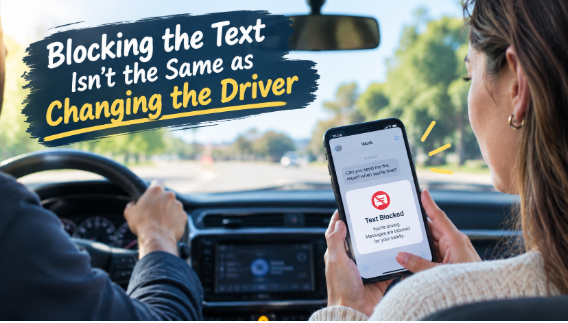
Most people who text behind the wheel don’t see themselves as reckless. They see themselves as careful drivers who looked down for a second. The phone buzzes in the cupholder, a message from a coworker or a school office lights up the screen, and the urge to check it is stronger than the promise made at the start of the drive.
That gap between intention and behavior is why a text blocker is worth a closer look. “I won’t use my phone while driving” is a rule the driver has to defend on every trip, at every red light, against every notification. “The phone isn’t allowed to demand my attention in the first place” is a different kind of protection, because it changes the situation instead of relying on discipline. It also has limits, and knowing them matters as much as knowing what the technology does.
Why Willpower Alone Keeps Losing
NHTSA reports that 3,208 people died in 2024 in crashes involving distracted drivers. That figure is probably low. Distraction is hard to document after a crash, and the National Safety Council notes that distraction-affected crashes are likely underestimated.
Observed behavior points the same way. NHTSA’s national roadside survey watches what drivers actually do instead of asking them. It found 4.5% of drivers manipulating a hand-held device at a typical daylight moment in 2024, up from 2.2% in 2015. Those percentages sound small until you picture how many drivers are on the road at any given minute.
Teens carry a particular share of the risk. NHTSA counted 241 teens aged 15 to 19 killed in distraction-affected crashes in 2023, about 9% of all teen traffic deaths that year. Reminders and house rules still matter, but they compete with a device designed to interrupt.
What Blocking Messages Actually Removes
Several different tools get lumped together under “phone controls.” They are not the same thing:
- Text blocking stops messages from reaching the driver, or from being sent, while the vehicle is moving. Exact behavior varies by product.
- Notification suppression silences alerts, but the phone stays fully usable if the driver picks it up.
- Driving mode or Do Not Disturb While Driving is a phone setting. On iPhone, Driving Focus silences or limits texts and other notifications, and can trigger automatically based on detected motion or a CarPlay connection.
- App restrictions limit which apps can be opened.
- Hands-free systems let drivers talk or dictate instead of typing.
- Driver monitoring observes and reports behavior without necessarily blocking anything.
- Vehicle-level technology is built into the car itself.
A text blocker works on one link in the chain: the incoming message. That removes the glance at the screen, the quick reply at a stoplight, and the social pressure of leaving someone unanswered. Auto-replies help with that last part, since Apple’s Driving Focus can send a customizable reply to people who message while it is on. The sender learns you’re driving, and the driver doesn’t have to decide anything in the moment.
None of this makes a drive safe. It removes one common and avoidable trigger.
What It Can’t Touch
The limits matter most here, because a driver who believes a tool covers everything may relax in ways that make things worse.
Mental distraction is the clearest example. AAA Foundation research led by University of Utah psychologist David Strayer found that hands-free calling and speech-to-text messaging place a high mental burden on drivers, leading to missed visual cues and slower reactions. A follow-up in 2015 tested voice systems in ten vehicles and three smartphone systems. It found that practice reduced the mental distraction but did not eliminate it. These were controlled workload measurements, not crash-rate data, and they are not recent, but the core point still holds: eyes on the road and hands on the wheel don’t guarantee attention on driving.
A text blocker also does nothing about:
- Emotional distraction, such as a tense phone call just before the drive or an argument with a passenger
- Fiddling with navigation or music
- Talkative passengers or unsettled kids in the back seat
- Speeding, fatigue, and other risky habits
Blocking a message isn’t the same as eliminating distraction.
The Part Most Articles Skip: Whether People Use It
A control only helps if it is turned on and stays on. Researchers studying teen drivers have tested this directly. One approach asks drivers to remember to switch an app on before the trip (opt-in). Another activates automatically when the car moves (opt-out). A third alerts parents when a teen overrides the block. The design choice shapes behavior because it decides how much the driver has to do.
Adult drivers are not reliably better. A study of adolescents and parents in Philadelphia noted that some research has found that fewer than 25% of adult drivers use Do Not Disturb or similar functions. Its authors concluded that phone-based tools seem feasible and acceptable for novice drivers but are unlikely to produce lasting behavior change by themselves.
That is the gap between a tool and a habit. Teens notice what their parents do, and a separate LifeSaver app study argued for a family approach, since interventions aimed only at teens are unlikely to work if parents drive distracted in front of them. For fleets, the equivalent is a written policy that managers follow themselves.
Where It Fits in a Broader Safety System
The most realistic way to think about a phone control is as one layer. A workable routine might include:
- Setting navigation and music before the car moves
- Keeping the phone out of reach, not just silenced
- Using built-in vehicle features when available
- Agreeing in advance on when a message can wait, and who answers for a driver
The last layer is technology. Well-designed safe driving technology can make the safe choice the default, but it works best when it supports expectations people have already agreed to. Teens respond differently when a parent explains the rule and follows it too. Employees respond differently when a policy is explained and enforced consistently instead of rolled out quietly.
Questions Worth Asking Before Choosing a Tool
Before parents or employers commit to any tool, it helps to ask:
- Does it start automatically, or does someone have to remember? Automatic activation removes one point of failure.
- Who can turn it off, and does anyone find out? Transparency about overrides is part of how families and employers build trust.
- What still works? Navigation and emergency calls should not be casualties of blocking.
- How does it treat passengers? Motion-based detection can’t always tell a driver from someone riding along.
- What data does it collect, and who sees it? This matters for teens and especially for employees.
- Does the person using it understand why? Buy-in often decides whether a text blocker stays enabled.
The Takeaway
Blocking messages removes one important source of phone distraction, and that is worth something, because it takes the decision out of a moment when good intentions tend to fail. But distracted-driving prevention works best when technology is paired with clear expectations, consistent habits, and attention to the distractions a phone tool can’t reach. A text blocker works best as part of that larger routine. Providers such as My Drive Guardian offer text blocking and related tools for distracted-driving prevention, and the same questions apply when comparing any of them.
FAQs
What does blocking texts while driving actually do?
It stops messages from reaching the driver, or being sent, while the vehicle is moving, which removes one common prompt to look at the phone. Specific behavior varies by product, so check what is blocked and what is still allowed.
Can text blocking eliminate distracted driving?
No. It doesn’t address mental distraction, emotional distraction, navigation and music handling, passengers, or other risky behaviors. AAA Foundation research shows that hands-free interaction can still be mentally demanding.
How is blocking texts different from Do Not Disturb While Driving?
Do Not Disturb or Driving Focus is a phone setting that silences or limits notifications. Dedicated blocking tools may go further, but features vary, and drivers can often turn phone settings off or change how they trigger.
What should parents consider when using phone-blocking tools with teens?
Explain the rule before enforcing it, choose a tool that activates automatically if possible, decide together who is notified about overrides, and follow the same rules yourself. Research on teen drivers suggests tools alone rarely produce lasting behavior change.