A trading firm in Dubai holds cash in AED, SAR, and USD. Three currencies. Three banks. Three separate views of the same firm. Nobody at head office can say, right now, how much cash the group actually has.
This happens all the time across the GCC. A firm grows into Saudi Arabia, Oman, or Qatar, and cash spreads out with it. Each new entity brings another bank, another currency, another blind spot. A good treasury management system UAE firms actually trust pulls it all back into one view. That gap is often the real reason cash quietly bleeds out through fees nobody notices.
This guide covers cash pooling, why split-up cash costs more than it looks, and steps to fix it.
Why Multi-Currency Cash Management Is Becoming a Challenge for GCC Businesses?
Growth Across Borders Creates Financial Complexity
Move into a second GCC country, and things don’t get harder slowly. They jump. New arm, new bank, new report rules often overnight.
Why Fragmented Cash Creates Hidden Costs
Idle cash sits in one account while a sister firm borrows, at real cost. Small FX swaps eat margin quietly. Bank fees stack up across five ties instead of one.
Cash doesn’t have to be scarce to become costly; poor sight alone can drive costs up.
Understanding Multi-Currency Cash Pooling
What Is Multi-Currency Cash Pooling?
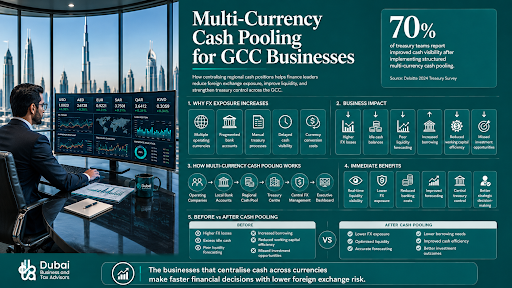
It’s a way to combine cash from different accounts and currencies into one view. Instead of five separate pots, you get one clear picture.
How Cash Pooling Works?
Cash gets pulled into one place, so the head office sees the group’s true cash spot at any time. Surplus in one arm offsets a gap in another set on auto, or on a fixed schedule.
Types of Cash Pooling
| Feature | Physical Pooling | Notional Pooling |
| Cash movement | Actually moved between accounts | Stays put, balances offset on paper |
| Complexity | Simpler to set up | Needs stronger bank deals |
| Best for | Groups wanting real merge | Groups wanting to avoid moving funds |
Why GCC Businesses Lose Money Without Cash Pooling?
Loans happen even when the group holds plenty of cash just in the wrong arm. FX costs rise from swapping currencies more than needed. Cash sits stuck, one entity at a time, while calls get delayed for lack of a clear view. Bank charges stack up across accounts, and good deals get missed simply because nobody could confirm funds in time.
How Multi-Currency Cash Pooling Reduces FX Exposure?
Fewer swaps happen once cash gets pooled, since surplus in one currency can cover a gap in another before anyone needs to convert. Timing gets better too as treasury teams swap when rates favour them, not just out of daily need.
Group-wide cash flow gets genuinely stronger. Treasury grip tightens. The business gains real room to move fast when a good deal shows up.
The Role of a Treasury Management System
What a Treasury Management System Does?
A solid treasury management system UAE firms rely on linking every bank account into one live screen. Real cash spots show up, not yesterday’s stale numbers.
How Treasury Systems Support Cash Pooling?
- Links to many banks, across firms and countries
- Live cash sight, all the time
- Auto cash positioning
- FX exposure reports
- Forecasts that reflect real, current data
Why Manual Treasury Processes Fall Short?
Spreadsheets break under multi-currency load. Checking figures eats hours. Reports fall behind real life, and small slip-ups pile up fast across several currencies.
Cash Pooling vs Other Treasury Approaches
| Approach | Best For | Key Limitation |
| Cash pooling | Groups with many entities or currencies | Needs bank buy-in across borders |
| Cash concentration | Single-currency groups | Doesn’t handle FX well |
| Treasury system | Ongoing sight and grip | Needs upfront setup |
| Spreadsheets | Very small, simple runs | Breaks fast past a few accounts |
Practical GCC Business Scenarios
A regional trading firm couldn’t tell which arm held spare cash. Pooling pulled sight into one place, cutting needless loans within one quarter.
A manufacturing group across three countries kept swapping currencies daily. Better pooling timing cut FX costs by a real margin come year-end.
A firm expanding into Saudi Arabia, UAE, and Oman faced three separate bank ties with no shared view. A treasury system gave the head office one screen, cutting report time from days down to hours.
Is Multi-Currency Cash Pooling Right for Your Business?
Signs you’ve outgrown manual treasury:
- Multiple bank accounts across entities
- Regular FX swaps
- Separate finance teams reporting differently
- Manual, spreadsheet-based reports
- Real gaps in cash sight
Trading firms, factory owners, logistics firms, and family-run groups growing across the GCC tend to gain the most.
Best Practices for Implementing Multi-Currency Cash Pooling
- Look honestly at your current cash setup
- Review your bank ties
- Build a clear treasury policy
- Set one shared way to report across every entity
- Pick treasury tech that fits your real scale
- Track key numbers idle cash %, FX costs, forecast accuracy, loan costs
Common Mistakes That Increase FX Exposure
Running each entity on its own is the biggest one. Leaning on spreadsheets past a certain size comes close behind. Delaying FX calls, ignoring idle cash, and weak treasury oversight all quietly stack up the cost over time.
Common Myths About Multi-Currency Cash Pooling
| Myth | Fact |
| Only big multinationals use cash pooling | Growing GCC SMEs increasingly use it too |
| It wipes out all FX risk | It cuts exposure, not wipes it out fully |
| ERP systems replace treasury tools | ERPs run daily work; treasury tools manage cash on their own |
| SMEs don’t need treasury tech | Cloud pricing has made it truly within reach now |
Frequently Asked Questions
What is multi-currency cash pooling, in plain terms?
It’s combining cash from different accounts and currencies into one view, so a firm always knows its true group-wide cash spot, instead of guessing across separate entities.
Is cash pooling suitable for SMEs, or only large groups?
Increasingly, yes, for SMEs too. Cloud-based treasury tools have brought setup costs way down, making pooling real for growing GCC firms, not just big multinationals.
Is cash pooling allowed across GCC countries?
Generally, yes. Exact setups depend on each country’s bank rules and your bank’s cross-border deals worth checking details with your banking partners directly before you start.
Can treasury software actually link with existing ERP systems?
Yes, most modern treasury tools link with common ERP systems rather than replacing them, since the two do different jobs. Your ERP runs daily work, while the treasury tool focuses on cash, cash flow, and FX exposure across every entity.
When should a growing business actually invest in a treasury management system?
Usually once you’re running more than two or three bank accounts across different entities or currencies, spreadsheets start eating real hours each week just to stay checked and balanced. Waiting until cash sight becomes a real crisis tends to cost more than acting early.
Conclusion
Split-up cash quietly costs more than most finance leads realise through needless loans, avoidable FX swaps, and calls delayed for lack of a clear view. Multi-currency cash pooling fixes the sight problem head-on, and the right treasury management system uae firms pick makes it last as you keep growing.
Dubai Business & Tax Advisors helps GCC firms see where their treasury setup actually stands today, then builds practical cash pooling plans suited to their real scale whether that means reviewing bank ties, picking the right tech, or helping finance teams build reports that grow with the business. Worth checking your setup now, honestly, before a move into another GCC market makes things harder to untangle.