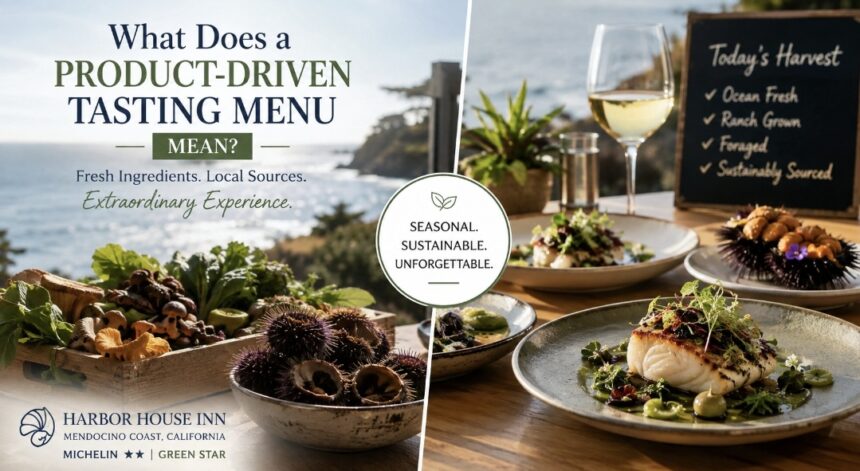
A product driven tasting menu is a chef tasting menu built around the finest ingredients available at a particular moment rather than a fixed collection of signature dishes. Seasonal harvests, local seafood, regional produce, and responsible sourcing guide the menu. That allows chefs to showcase each ingredient at its natural peak. Harbor House Inn on the Mendocino Coast demonstrates this philosophy through Chef Matthew Kammerer’s hyper local approach.
The Usual Way Restaurants Work
Most kitchens start with a recipe. The chef develops a dish, perfects it, prints it on a menu, and then orders whatever ingredients are required to make it. That chicken dish stays the same in July and January. The ingredients get bent to fit the recipe. Often they’re not at their best, but the menu demands them anyway. It’s efficient. It’s predictable. And it produces food that tastes fine, but rarely alive.
The Product Driven Way Works Backwards
A product driven kitchen flips that entire process. The ingredients arrive first. The ranch manager reports what’s ready to harvest. The fisherman calls in with what came up on the boat. The forager appears with mushrooms that weren’t there yesterday. Only then does the menu take shape.
If the kohlrabi looks exceptional, kohlrabi becomes a dish. If the diver brings sea urchin, sea urchin takes center stage. Nothing gets forced. Nothing gets flown in from another continent because a printed menu demands it. This is what an honest California tasting menu looks like.
And here’s the thing. It’s how kitchens worked long before global supply chains made every ingredient available all year. Product driven cooking isn’t a new idea. It’s a return to something older and more grounded.
The Hidden Cost of Fixed Menus
Think about asparagus in December. Where does it come from? Peru, usually. Or a heated greenhouse. Either way, it traveled thousands of miles or required enormous energy to grow out of season. It will not taste the way asparagus tastes in April, when it pushes out of the soil on its own.
A product driven menu avoids all that. Asparagus shows up for a few weeks in spring, then disappears. The kitchen moves on to whatever’s next. No forced imports. No bland off-season produce. This is sustainable fine dining in practice, not in a press release.
Choosing a Restaurant for a Special Occasion
When you’re picking a fine dining restaurant for a big night, the menu and the view get most of the attention. But the most memorable experiences share a few quieter traits. The food is genuinely excellent. The service feels personal, not performed. The ingredients are seasonal and local. And the whole place feels connected to its region instead of floating above it.
The Michelin Guide helps here. It tells you a restaurant delivers consistency. And in some cases, that it takes sustainability seriously. But the setting matters too. A dining room with a view of the ocean or the forest adds a layer of meaning that no chandelier can match.
For travelers looking for a Michelin dining experience, a restaurant that connects its food to its surroundings can make the meal feel more personal. At Harbor House Inn California, that connection extends from the dining room to the ranch, forest, and ocean beyond it.
What Harbor House Inn Actually Does
Harbor House Inn sits on a bluff in Elk, California, a tiny town about twenty minutes south of Mendocino proper. The building went up in 1916. The Pacific fills the windows. Chef Matthew Kammerer runs the kitchen, which holds Two320-acreN Stars and a MICHELIN Green Star.
A 320 acre Harbor House Inn Ranch grows much of the produce, herbs, and eggs. The ocean right outside supplies rockfish and sea urchin when they’re abundant. The coastal forest gives up wild mushrooms, seaweed, and herbs gathered by hand. The menu changes every single day because the ingredients change every single day.
“The ecosystem writes the menu. Some days it comes together fast, some days it shifts halfway through prep.” That flexibility is the entire point. A fixed menu would lock the kitchen into ingredients that might not be at their best. A product driven menu lets the day decide what’s for dinner.
That approach is central to the Chef Matthew Kammerer restaurant experience. It also gives the property a strong connection to hyper local cuisine, where the surrounding landscape directly influences what reaches the table.
Why This Supports Sustainability
Product driven kitchens waste less. If the menu is overordered, there’s no need to overorder or overprepare. Short supply chains mean less fuel, less packaging, less refrigeration. Local sourcing keeps money in the community instead of sending it to a distributor three states away.
Harbor House Inn extends this logic everywhere. The whole property runs on 100 percent renewable energy from local sources. Kitchen water gets reused for garden irrigation. Old fryer oil becomes candles. The MICHELIN Green Star, awarded in 2020, recognizes exactly this integration. It’s not a side project. It’s the same philosophy applied to every corner of the operation.
That combination of food, sourcing, and environmental care is part of what makes the property an example of sustainable gastronomy. It also helps explain why it stands out among restaurants along the Michelin Restaurant California Coast landscape.
What You Notice as a Guest
Most diners never think about any of this. They just notice the food tastes vivid. A tomato picked hours ago tastes more like a tomato than anything from a supermarket. A piece of fish that was swimming yesterday has a sweetness you can’t fake.
Guests who visit Harbor House Inn twice in a year will have two completely different meals. That unpredictability is the point. It’s destination dining in the truest sense. The food doesn’t just reflect the region. It couldn’t exist anywhere else.
For a romantic coastal getaway in California, travelers might plan around a special meal, that sense of place matters more than any gold leaf. The experience also fits naturally into a luxury stay Mendocino, where the food, landscape, and lodging all feel connected.
The property itself works as a luxury inn Mendocino Coast visitors can use as a base, rather than simply a restaurant they visit for a few hours. Its setting gives the Michelin Star restaurant Mendocino experience a distinctly coastal character.
What Home Cooks Can Steal
You don’t need a Michelin kitchen to cook this way. Shop seasonally. Let the ingredients inspire the meal instead of forcing a recipe. Buy from local farmers when you can. Keep preparation simple enough to let quality come through.
A ripe peach needs almost nothing. A fresh fish needs salt and heat. Product driven cooking isn’t about equipment or technique. It’s about paying attention to what’s around you and respecting it enough to get out of the way. That’s a mindset any home cook can adopt. And it will make your Tuesday night dinner taste better than anything from a delivery app.