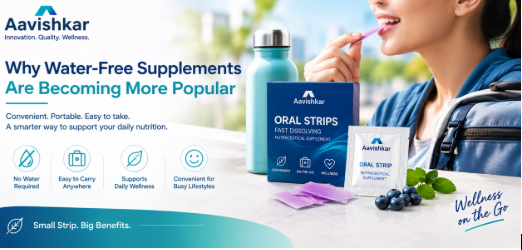
The way people consume nutritional supplements is changing. Traditional tablets and capsules remain common, but consumers are increasingly interested in formats that fit more easily into busy lifestyles. One format receiving attention is the water-free supplement, which can be taken without carrying a bottle or finding a glass of water. This shift is particularly relevant for people who travel frequently, work long hours, exercise outdoors, or simply prefer convenient daily nutrition.
Among the different water-free formats available today, oral dissolving strips have emerged as an interesting option. These thin films are designed to dissolve in the mouth, making supplementation possible without swallowing a conventional pill.
What Are Water-Free Supplements?
Water-free supplements are nutritional products designed to be consumed without requiring water at the time of use. They can come in different forms, including powders, chewables, gummies, lozenges, and oral films.
Oral strips are especially compact. A strip contains a measured quantity of active ingredients within a thin film. Once placed in the mouth, the film becomes hydrated through saliva and gradually dissolves.
This simple method can make supplementation easier in situations where water is not readily available.
For example, someone travelling on a long flight may not want to carry multiple bottles of water. A person attending an outdoor event may also find conventional supplements inconvenient. A water-free format can reduce one small barrier associated with daily supplement routines.
Why Convenience Matters in Supplement Use
Taking supplements consistently can be challenging when the routine feels complicated. People may need to remember several products, carry them throughout the day, and take them with meals or water.
Convenience does not determine whether a supplement is nutritionally appropriate, but it can influence how easily a person incorporates a product into their routine.
Water-free formats address one practical issue: the need for water during consumption.
A small oral strip can be carried in a wallet-sized package, pouch, or compact box. This makes the format suitable for travel bags, office drawers, gym bags, and other everyday settings.
Oral Strips Offer a Compact Delivery Format
One of the most noticeable characteristics of oral strips is their physical size. Unlike bottles containing dozens of tablets or capsules, individual strips can be packaged in a relatively compact format.
This can be useful for brands developing products for active consumers.
For instance, a daily vitamin strip can be designed for people who want a portable supplement option while travelling. Similarly, an electrolyte or wellness-oriented strip may appeal to consumers who prefer lightweight products.
The goal is not necessarily to replace every traditional supplement format. Instead, oral strips provide another delivery option for certain nutritional products.
The Growing Interest in On-the-Go Nutrition
Modern lifestyles have created demand for products that can fit around work, travel, fitness, and social activities.
Consumers increasingly look for products that are:
- Easy to carry
- Simple to consume
- Convenient during travel
- Individually packaged
- Suitable for busy routines
- Easy to incorporate into daily habits
This is one reason the concept of water-free supplementation has become increasingly relevant.
The format can be particularly interesting for brands looking to develop differentiated nutritional products. Instead of offering another conventional capsule, a company may explore an oral film format that gives consumers a different experience.
What Makes Oral Films Different?
Oral films are thin polymer-based sheets that contain selected ingredients. During manufacturing, ingredients are distributed through a film-forming matrix before the material is processed into individual strips.
The final product needs to provide consistent dimensions, appropriate texture, stability, and ingredient distribution.
This is where manufacturing technology becomes important.
A company looking for a health supplements oral thin film manufacturer needs to consider more than simply whether a film can be produced. Formulation compatibility, ingredient stability, dosage uniformity, packaging, flavor, and shelf-life considerations all need to be evaluated.
Ingredient Selection Is Important
Not every nutritional ingredient automatically works well in an oral film.
Formulators need to consider factors such as:
- Ingredient concentration
- Taste and odor
- Stability
- Compatibility with film-forming materials
- Moisture sensitivity
- Required serving size
- Desired dissolution characteristics
Some ingredients may have strong flavors or require relatively high quantities. These characteristics can create formulation challenges.
Flavor development therefore becomes an important part of product development. A well-designed oral strip should provide an acceptable sensory experience while maintaining the intended nutritional formulation.
Packaging Plays a Major Role
Water-free does not mean moisture-free.
Oral films can be sensitive to environmental conditions, particularly moisture. Packaging therefore plays an important role in maintaining the physical and chemical characteristics of the product.
Depending on the formulation and market requirements, manufacturers may evaluate individual sachets, protective pouches, blister-style packaging, or other barrier solutions.
The right packaging can help protect strips during transportation and storage while also making individual servings convenient for consumers.
How Manufacturers Support Product Development
The growth of water-free supplements has created opportunities for specialized manufacturers.
A manufacturer may support a brand through multiple stages, including formulation development, prototype preparation, film production, cutting, quality checks, packaging, and scale-up.
Aavishkar Oral Strips Pvt Ltd is an example of a company focused on oral dissolving film technology and private-label manufacturing. Its ThinSol™ technology is positioned around developing customized oral strip formulations for different applications.
For supplement brands, working with an experienced manufacturer can help connect formulation requirements with practical manufacturing considerations.
Water-Free Does Not Mean Better for Everyone
It is important to view water-free supplements as a format choice rather than automatically assuming they are superior to tablets, capsules, or other products.
Different consumers have different preferences. Some may prefer gummies, while others may be comfortable with capsules or powders.
The value of a water-free format comes from the convenience it provides in particular situations.
Brands should therefore focus on matching the delivery format with the intended audience, ingredients, dosage requirements, and usage occasion.
The Future of Convenient Supplement Formats
As supplement consumers continue to seek practical products, water-free formats are likely to remain an area of interest. Oral strips offer brands an opportunity to rethink how certain nutrients are packaged and consumed.
Their compact size, portability, and water-free use make them relevant to modern routines. At the same time, successful products still depend on careful formulation, quality manufacturing, appropriate packaging, and consumer-friendly design.
The growing interest in water-free supplementation reflects a broader change in the supplement industry: consumers increasingly want nutrition products that work naturally within their everyday lives.