Adam Sandler has spent more than three decades playing characters who yell, mumble, sing ridiculous songs, lose their tempers and behave as if adulthood arrived without instructions. That public image is so familiar that it can obscure the more interesting story behind it. Sandler is not simply the comedian from Happy Gilmore, The Waterboy and Big Daddy. He is also an unusually consistent Hollywood businessman, a fiercely loyal collaborator, a serious basketball obsessive, a family-centered filmmaker and an actor who respected directors have repeatedly trusted with difficult dramatic roles.
Sandler’s career also contains a contradiction that helps explain his longevity. Critics have sometimes treated his broadest comedies as disposable, yet generations of viewers keep returning to them. At the same time, movies such as Punch-Drunk Love, The Meyerowitz Stories, Uncut Gems, Hustle and Jay Kelly have given audiences a very different version of him. Those performances did not necessarily reveal a completely different actor. They exposed qualities—anger, vulnerability, anxiety, competitiveness and sadness—that had been sitting underneath the comedy all along.
The lesser-known stories from Sandler’s life make that contradiction easier to understand. His path into comedy was partly encouraged by his brother. One of the most important television jobs of his life ended with him being pushed out. Many of the people who appeared beside him when he was young still work with him decades later. He plays basketball with strangers even though he could organize private games with celebrities. His wife has influenced some of his most important acting decisions, while his daughters have gradually become part of his professional world. The more closely Sandler’s life is examined, the less random his career starts to look.
1. Before the Movie Star, There Was a Kid Who Wasn’t Sure What He Should Do
Adam Richard Sandler was born in Brooklyn, New York, on September 9, 1966, and his family later moved to Manchester, New Hampshire. His childhood is notable partly because it does not fit the standard mythology surrounding comedians. Sandler has spoken about growing up in a supportive family rather than describing childhood as an endless source of trauma. That matters because many of his later movies revolve around exaggerated conflict while ultimately returning to family, friendship and belonging.
Sandler did not describe his career choice as the result of a detailed childhood master plan. When he was considering college, his brother Scott helped point him toward performing. Sandler recalled during a 60 Minutes interview that he asked his brother what he should study, and Scott suggested acting and comedy. Sandler’s version of the decision makes it sound almost casual, although his behavior afterward suggests considerable ambition. He enrolled at New York University’s Tisch School of the Arts and graduated in 1988.
His early stand-up experiences also revealed something that remained part of his professional personality. Sandler could appear loose and silly while privately taking the work seriously. He performed comedy while still young and began developing the combination of songs, character voices, conversational storytelling and deliberate stupidity that would later become instantly recognizable. A guitar could also function as more than a musical instrument. Sandler has described holding it onstage as a kind of security blanket, giving him something physical to do while facing an audience.
Television arrived before most people knew his name. Sandler appeared as Smitty, one of Theo Huxtable’s friends, on The Cosby Show during the 1980s. He also appeared on MTV’s Remote Control. These were hardly star-making roles, but they placed him inside the entertainment industry while he was still developing his comedy. Sandler later admitted that even then he was highly driven. When 60 Minutes asked what kind of career he wanted, he pointed directly to Eddie Murphy’s path: television comedy followed by movie stardom.
That ambition is important because Sandler’s relaxed personality can make his success appear accidental. His clothes, speaking style and public interviews rarely communicate traditional Hollywood intensity. Yet a career lasting several decades at his level does not happen because someone casually wanders from project to project. Sandler repeatedly writes, produces, performs stand-up, develops movies, works with directors outside his own company and maintains long-term professional relationships. The casual surface disguises a disciplined working life.
Comedy eventually provided his entrance to Saturday Night Live. Comedian Dennis Miller saw Sandler perform and helped bring him to the attention of the people around the show. Sandler joined SNL as a writer in 1990 before becoming an on-air performer. Soon his songs and odd characters became part of the show’s early-1990s identity, particularly for younger viewers. Characters such as Opera Man and Canteen Boy were unmistakably Sandler: childish, musical, uncomfortable and strangely committed to their own absurdity.
His time at SNL also connected him with comedians who would remain important throughout his life. Chris Farley, Chris Rock, David Spade and Rob Schneider belonged to the same broader comedy generation, and their relationships continued long after their original television careers separated. Sandler later remembered the physical arrangement of their desks when revisiting the SNL offices, recalling Farley, Spade and Rock not as distant industry contacts but as people with whom he had spent some of the formative years of his adult life.
That loyalty would eventually become one of the defining features of Sandler’s career. Hollywood is famous for temporary friendships created by productions, publicity tours and business opportunities. Sandler built something closer to a traveling company.
2. Getting Fired From Saturday Night Live Changed Everything
Sandler’s departure from Saturday Night Live in 1995 was not a confident decision by a rising movie star who had simply outgrown television. He was effectively pushed out during a difficult period for the program. Lorne Michaels later described a moment when both network executives and critics were hostile toward that version of the show. Sandler remembered being encouraged to recognize that leaving might be the sensible option.
The firing hurt more than Sandler’s later jokes about it suggest. He told 60 Minutes that he was heartbroken and frightened, particularly because being rejected from a prestigious job meant having to tell other people that the institution had decided he was not good enough. That admission is revealing because rejection became a recurring subject beneath his comedy. Many Sandler protagonists are underestimated, humiliated or dismissed before finding some way to regain control.
The timing also makes the story more remarkable. Sandler left SNL during the same period when his movie career was starting to become viable. Billy Madison arrived in 1995, followed by Happy Gilmore in 1996. Neither movie represented conventional prestige filmmaking. Both established a character type that would follow Sandler for years: an emotionally immature outsider with explosive anger, unexpected sweetness and little respect for social rules.
Happy Gilmore was particularly important because it combined several interests that would recur throughout Sandler’s career. It used sports as a structure, surrounded Sandler with memorable supporting performers and allowed aggression to become comedy. Happiness does not calmly solve problems. He attacks them. The exaggerated violence is funny because Sandler’s characters often react to ordinary frustration with wildly disproportionate emotion.
Sandler eventually became comfortable enough with the SNL firing to turn it into material. When he returned to host the show in 2019, nearly a quarter-century after leaving, his opening monologue revolved around a song about being fired. He even brought Chris Rock into the routine and joked about the strange trajectory that followed his dismissal. The humor worked because the audience already knew the ending: Sandler had survived.
The same episode contained something much more emotional. Sandler performed his musical tribute to Chris Farley, who died in 1997 at age 33. The friendship between the two comedians had remained important to him long after Farley’s death. Sandler said he became emotional while rehearsing the song at SNL because he was performing it in the place where they had spent so much time together. He remembered Farley as the comedian their group regarded as the funniest among them.
Farley’s death also gives Sandler’s later obsession with keeping old friends close to a different emotional weight. It is easy to joke that Sandler makes movies primarily so that he can employ his buddies and travel with them. There is some truth behind the observation—familiar faces appear constantly in his work—but the pattern can also be viewed as a deliberate way of maintaining relationships inside an industry built around constant separation.
That approach became institutionalized after Sandler’s early movie success. Happy Madison Productions was founded in 1999, with its name combining Happy Gilmore and Billy Madison. The company’s films repeatedly employed actors, writers and filmmakers from Sandler’s existing network. Even the production company’s identity contains a family connection: company descriptions note that the older man associated with the Happy Madison logo is Sandler’s father, Stanley.
Hollywood careers usually require reinvention, but Sandler found another strategy. He built an ecosystem.
3. The Sandler System: Friends, Basketball and a Surprisingly Durable Business
Sandler’s repeated use of familiar collaborators has become so noticeable that viewers can almost play a game of spotting them. Rob Schneider, David Spade, Kevin James, Steve Buscemi, Allen Covert and numerous other performers have returned across different movies. Tim Herlihy, whom Sandler has known since their university years, became a major writing and producing collaborator. Directors such as Dennis Dugan also returned for multiple productions.
The system can look informal from the outside, but it serves a practical purpose. Comedy depends heavily on rhythm and trust. Working repeatedly with people who understand the intended tone can shorten the distance between an idea and a finished scene. Sandler also reached a level of commercial success where he could create opportunities for people around him instead of competing with them for the same handful of roles.
Happy Madison expanded that approach beyond Sandler’s own starring vehicles. The company developed movies built around members of his wider comedy circle and became a recognizable brand in its own right. Sandler was no longer simply an actor trying to get cast. He had become part of the infrastructure that decided which movies would be made.
His business career is especially interesting because it contrasts so sharply with his public appearance. Sandler rarely dresses like a studio executive. His uniform frequently involves huge basketball shorts, oversized shirts, sneakers and clothing that seems selected primarily for comfort. At times he looks less like one of Hollywood’s most commercially successful comedians and more like someone who has just finished stacking restaurant chairs after the end of a long shift.
That indifference to fashion eventually became fashionable itself. Social media users and style publications began treating his oversized clothes as a recognizable aesthetic, sometimes calling it “Sandlercore.” The joke is that Sandler appears to have achieved fashion influence partly by refusing to participate seriously in fashion. His wardrobe reinforces the broader character people associate with him: wealthy enough to dress however he wants and apparently uninterested in proving that wealth through clothing.
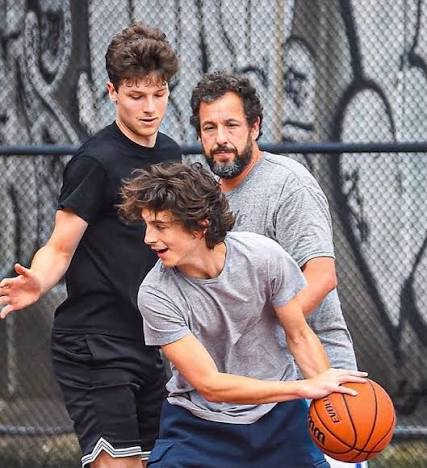
Basketball offers an even clearer view of his personality. Sandler has played the sport obsessively for years and has a reputation for appearing at ordinary pickup games rather than limiting himself to private celebrity courts. ESPN collected stories from players who encountered him at recreation centers and gyms, often with little ceremony. Accounts describe him as a pass-first player who understands the game, competes seriously and frequently shows up in the same enormous clothing he wears elsewhere.
Sandler has said that at one point he played pickup basketball five or six times per week and sometimes every day. His approach also seems social rather than purely athletic. Players interviewed about their encounters with him often emphasize his passing. That detail fits his professional life unusually well: he likes being involved, but he also seems comfortable giving other people opportunities to score.
Basketball eventually became central to Hustle, the 2022 movie in which Sandler plays NBA scout Stanley Sugerman. The movie surrounded him with professional players and people who genuinely understood basketball. The authenticity mattered because Sandler’s own interest in the sport was not something invented for publicity. Shaquille O’Neal and others have publicly praised his ability, particularly his understanding of the game and his passing.
The basketball stories also complicate the assumption that Sandler lives entirely inside a protected celebrity environment. A person with his resources could arrange private gyms, trainers and carefully selected opponents. Instead, stories repeatedly emerge about him showing up at public courts and trying to get into the next game. One ESPN account described Sandler arriving without fanfare, playing seriously and leaving much the same way.
That accessibility helps explain why Sandler’s relationship with audiences has remained unusual. People may criticize individual films, but the performer himself has rarely developed the distant aura associated with some stars of comparable wealth. His clothes, basketball habits and longtime friendships make his fame look almost strangely domestic.
4. Family Became Part of the Work Instead of Something Separate From It
Sandler’s relationship with Jackie Titone began around the period when his movie career was accelerating. Jackie appeared in Big Daddy, released in 1999, and the couple later married in 2003. They have two daughters, Sadie, born in 2006, and Sunny, born in 2008. Jackie has continued appearing in Sandler projects while the daughters gradually began appearing as well.
Family involvement eventually became much more visible than a few cameos. You Are So Not Invited to My Bat Mitzvah placed Sunny and Sadie Sandler in substantial roles alongside their father, while Jackie also appeared in the movie. Sunny had recently experienced her own bat mitzvah before filming, giving the production an unusual overlap between fictional coming-of-age comedy and the family’s real life.
The obvious accusation is nepotism, and Sandler has never pretended that his children entered the industry without access. Yet the family collaborations fit a pattern that predates his daughters’ acting careers. Sandler has spent decades blending work and personal relationships. Friends become cast members. Vacations resemble movie locations. Basketball follows him onto productions. Family members travel with him. Rather than maintaining a sharp division between Hollywood and ordinary life, he repeatedly pulls the two together.
Sandler explained that approach directly in a 2025 interview. Movie production can take actors away for long periods, so when possible, he tries to keep his wife and children nearby. He described the sacrifices required by a demanding career and acknowledged that the family absorbs some of those costs as well.
Jackie’s role in Sandler’s career also extends beyond appearing in his movies. Sandler has said that his wife encouraged him to accept Uncut Gems when he had doubts about taking the role. Jackie later explained that when she believes a part suits him, she tells him why audiences might want to see him play that kind of character.
That decision mattered because Howard Ratner in Uncut Gems became one of Sandler’s most acclaimed performances. The character is exhausting: a New York jeweler and compulsive gambler who cannot stop increasing the risk around him. Sandler speaks rapidly, lies instinctively, improvises constantly and treats disaster as another opportunity to place a bet.
Yet Howard Ratner does not feel disconnected from Sandler’s comedy characters. Billy Madison, Happy Gilmore and Bobby Boucher also struggle with impulse control and emotional regulation. The difference is consequence. In the comedies, extreme behavior resets after the joke. In Uncut Gems, every reckless decision remains in the story and creates another problem.
Paul Thomas Anderson recognized that dramatic potential much earlier when he cast Sandler in Punch-Drunk Love in 2002. Barry Egan is socially awkward, lonely and capable of startling eruptions of rage. The performance works because Anderson does not eliminate traits associated with Sandler’s comedy. He changes the environment around them. Anger that might lead to a slapstick fight in another movie becomes unsettling. Childlike vulnerability becomes heartbreaking rather than cute.
Noah Baumbach later used another side of Sandler in The Meyerowitz Stories, while Hustle drew on his love of basketball and his ability to portray disappointment without exaggerating it. His later collaboration with Baumbach on Jay Kelly continued that dramatic thread. Sandler has explained that he approaches demanding roles with intense preparation and wants to finish a workday without feeling that he held something back.
The serious performances therefore do not represent a late-career discovery that Adam Sandler suddenly learned how to act. They show what happens when filmmakers take familiar Sandler characteristics and remove the safety mechanisms of broad comedy.
5. What Adam Sandler’s Career Looks Like When the Jokes Are Removed
Sandler’s longevity makes more sense when viewed through relationships rather than box-office statistics. Many entertainment careers involve leaving earlier collaborators behind as status increases. Sandler repeatedly did the opposite. Friends from comedy clubs, college, television and early films continued appearing throughout his work. His production company created a structure where those relationships could survive commercially.
His father also remained important to the identity of Happy Madison. Stanley Sandler died in 2003, but the company’s branding kept a small family connection embedded inside hundreds of millions of dollars’ worth of entertainment. That detail is easy to miss because Happy Madison’s movies are usually discussed in terms of crude jokes, famous actors and reviews rather than the personal history behind the company.
Chris Farley’s memory similarly stayed present. Sandler’s Farley song is striking because it temporarily removes the protective irony he normally uses when discussing emotional subjects. He jokes within the song, but grief drives it. The performance suggests that nostalgia in Sandler’s work is not merely a commercial strategy aimed at viewers who grew up in the 1990s. He appears genuinely attached to the people and periods that formed him.
Recognition from the comedy establishment eventually caught up with that longevity. In 2023, Sandler received the Kennedy Center’s Mark Twain Prize for American Humor, joining a group of comedians honored for their impact on American comedy. The ceremony brought together longtime friends and collaborators including Chris Rock, David Spade, Drew Barrymore, Jennifer Aniston, Conan O’Brien and others.
The award represented an interesting reversal. Sandler had spent much of his career in movies that many critics dismissed. Yet the comedians and filmmakers who worked with him often talked about him differently. By the time of the Mark Twain Prize, the debate was no longer simply whether movies such as Billy Madison or Happy Gilmore deserved serious critical respect. Sandler himself had become part of American comedy history.
His appeal to younger viewers adds another layer to that history. Movies from the 1990s and early 2000s continue circulating through streaming platforms, clips and references. A teenager discovering Happy Gilmore now encounters a movie released decades before his or her birth, yet the character’s frustration, competitiveness and refusal to behave properly remain easy to understand.
Sandler also avoided completely abandoning the audience that originally made him successful when critics began praising his dramatic acting. After Punch-Drunk Love, he returned to broad comedy. After The Meyerowitz Stories, he made more mainstream projects. After Uncut Gems, he did not announce that he was finished with silly movies. He simply continued moving between them.
That refusal to treat one type of work as an apology for another may be one of the most important reasons his career has survived. Sandler does not appear desperate to convince viewers that the immature comedian they enjoyed was secretly beneath him. The old songs, ridiculous voices and explosive characters remain part of the same career as Howard Ratner or Barry Egan.
His life outside the screen follows a similar pattern. The successful producer is still the man searching for pickup basketball games. The international movie star dresses as if celebrity styling were an inconvenience. The actor who works with prestigious directors continues making movies with people he has known for decades. The father who spends months on sets increasingly brings his family into the filmmaking process instead of keeping those worlds separate.
Adam Sandler’s most interesting achievement, then, may not be any single film. It is the creation of a career in which enormous commercial success did not require him to erase the environment from which he came. Friends stayed friends and frequently became employees or collaborators. Family entered the movies. Basketball remained basketball even when NBA players started joining him. Rejection at Saturday Night Live became a joke he could eventually sing on the same stage.
The man behind the exaggerated characters also appears more ambitious than his image initially suggests. Sandler wanted an Eddie Murphy-style career while he was still young, worked toward SNL, survived being dismissed from it, became a major movie star, built a production company and later proved capable of carrying some of the most stressful dramatic films of his era. The baggy clothes and casual interviews can hide that trajectory, but they do not contradict it.
Sandler’s story ultimately works because the contradictions never disappear. He can make juvenile comedy and deliver a painful dramatic performance. He can run a major production company while looking completely uninterested in executive culture. He can build movies around famous actors and then spend his free time playing basketball with strangers. He can turn professional rejection into a comedy song while still admitting that the original experience broke his heart.
Those contradictions make Adam Sandler more interesting than the familiar image of the loud comedian who became rich making silly movies. His career is really a story about ambition disguised as casualness, loyalty inside an unstable industry, and an unusual ability to bring the same people and interests along while moving from comedy clubs to television, blockbuster films, streaming deals and acclaimed dramatic performances. The characters may keep changing, but the world around Sandler has remained remarkably consistent.